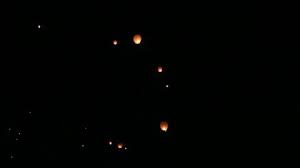
“Chinese Lanterns” was the winner of the Rilla Askew Prize for Fiction, and was published in “Conclave: A Journal of Character.”
You share your child with a person you don’t know, just because that person is now sleeping with your former husband: that’s the deal. You pull up, get out of the car, kiss your child goodbye, and hand her backpack to her. You wave at the woman in the doorway, your old doorway.
You try to convey adultness, a peacefulness you don’t feel. My god, she just stands there, smiling, waiting for your child to traipse up the walk. What is she thinking? And then, like any mother, she puts her hand on your child’s shoulder and says something to her you’ll never hear, smoothly moving her into the house. What is it? What could it be?
The back of your girl’s dark-haired head, her backpack, her rainbow polka dot rain boots disappear and the door shuts between you, all gone, poof! You look around, to see if the neighbors are watching, curtains twitching. You have to move, you have to get back in the car. You can’t let yourself run up and bang on the door, demanding your child. This is the arrangement, and it has its rules.
You drive to your apartment, dazed. You shouldn’t be driving, is what I think, you’ve had a shock and need tea, need pats from soothing hands. It’s all wrong, isn’t it? That woman is with your child as often as you are, filling out half the joint custody dance card along with your ex. Her hip, narrow figure in its narrow, hip jeans stays in your mind. Her shirt falls loosely over her flat belly. Her hair has a way of swinging across her cheek—she must get it styled in one of those places with graffiti for wall décor, the kind that gives people her age a cheap beer, gratis, to help them bear the boredom. She’s a Pilates teacher! But a good mom—am I right?—a good mom has no time to work on her abs.
How can this have happened to you, to all three of you, to your little family? You spent years picking a person to have a child with. And so, ok, maybe you picked wrong. But this, this Pilates woman, pushing her way in? You never picked her.
Finally you get an overdue, in-person, stiff introduction to her. Her name will be Breen, or Wyatt, or some name that shakes off everything too-female with it, anything like wide hips, like a belly. This is Kenton, your ex will say to you, or this is Nez.
Of course it is. And that she will always be younger than you, that he doesn’t have to say. You try not to stare at the place on her torso where a normal person’s stomach would be.
She has big dark eyes, with expressive-looking eyebrows that she nevertheless doesn’t allow to express anything to the likes of you. The eyebrows are kind of impressive, they way a holstered gun is impressive. Your ex too is poker-faced. They are united, stickily in sync.
You’ve heard a little bit from your daughter about this person: she lets your daughter stay up as late as she wants, lets her jump on the bed, lets her fall asleep watching TV after eating an entire box of Jolly Rancher popsicles. Coming from a child, you know these things are suspect. But still, but still.
Your ex says your own boring name to her and she extends her hand towards you, begrudgingly, like it’s a hostess gift for a hostess who made her sleep in a dirty bed. You manage to shake it like a grownup. Anyway you manage not to rake her palm with your fingernails. That’s something. Then you stride away from them, down the sidewalk, to fix your daughter’s costume, you say.
You’re done with him. It’s not about that. It’s about the way your brain recorded everything, through no fault of your own—etched into you are the thousands of times his face prepared itself for laughter, eyes brightening before the sound came. The soft spot on his neck where you buried your nose every night, the quiet way he always placed his feet on the floor when he got out of bed, thinking you were still sleeping, not wanting to wake you. The proud way he carried your daughter when she was so small, and the way he tapped out a silly song with his fingertip on her nose. All of it, breathing, kissing, fighting—it’s all a permanent, undismantled record inside you. You might be done with him. You really think you are. But you made a child. And now your child has suddenly gone public, communal, is suddenly possessed by the proverbial village whose help you don’t want.
While you fuss with untying and retying the ties on her cape, your daughter stamps her feet, eager to ring doorbells. You see out of the corner of your eye that your ex and the Pilates teacher are entwined, whispering to each other, the gusts of wind carrying their voices your way. Are they talking about your daughter, or you? Witch, they are saying, or bitch, maybe. He’s hunched over her like a goofy high school boy and she’s serene under his massive attention, brows motionless. He meets your eyes and looks away, defiant, pushing it, as if he doesn’t owe you a single thing.
Defiant? You catch yourself. What does he owe you, anyway? You wonder what has he said about you. Not everything, you hope. Not nothing, you hope.
The three of you follow your daughter around the neighborhood. You reel out the distance, trying to separate yourself from the two of them while still staying close to your daughter. If someone (me say) saw all this in aerial view, flying above it (if only I could!) I would see the triangle the three of you make becoming more and more elongated, with you as its furthest, most acute point.
The tension reminds you of a tango lesson your friends insisted you take, a singles-night disaster, where you had to let odoriferous men take you into their arms, way too close. You used the strength of your arms to keep them at bay, all while not getting caught out in this insulting way of behaving. You are not allowed to think they are odoriferous! Tangoing is so fun, so sexy, so life-affirming! Different men push at you, and you push back, pretending to be dancing.
Now, tonight, you put as much distance as you can between yourself and him and her, between their bodies and yours, as much as you can without making it obvious what you are feeling. What are you feeling? Your daughter and her friends go up to and back from the doorways, and the snatches of dialogue gust back to you.
Trick or treat.
And what are you? Are you a calculator?
What’s a calculator?
Oh, I see, a computer. And a banana, and a witch.
Not a computer, an iPad.
Oh, sorry, sorry, an iPad.
The kids race back, picking the next house: Mom, mom, your daughter asks, is this house ok?”—hopeful that any dimly lit upper room, or even just the withdrawn blue of a TV flashing, is an invitation to ring the bell. Does your ex see how vulnerable she is, how trusting? He doesn’t look worried. He never looks worried.
A little girl dressed as a pioneer wanders out of the dark, her bonnet slipping, her candy-gathering device a wooden bucket, all the parts of her costume clearly fact-checked by her mother, including her big 19th century eyes, haunted and greedy. At least, you think, people back then had the decency to stay married or at least to die in childbirth. Back then there were no chagrined clumplets of adults herding a dazed child: old wife, new girlfriend, ex-husband, new boyfriend, leftover this, rejected that, shuffling around without knowing the steps to this dance. The little pioneer fades into the darkness and a moment later a storm trooper with his blaster gun drawn and firing pursues her, making you jump. You touch your chest with an embarrassing old-person movement and Kenton/Nez sees you. You look away, cough.
Under a streetlight your daughter stops to open her pillowcase and show you her current haul. Her peaked hat makes her seem taller, its tip comically—like an arrow—pointing out the direction in which she will rapidly keep growing. You bend towards her, looking at the junky candy at the bottom of the sack, trying to match her happiness. She offers you and your ex pieces of the types she likes the very least, an almond candy bar for him and a taffy wrapped in her least favorite color, green, for you. She grins, and you want to grin too, because the girlfriend, what’s her name—Breen? Wyatt? has been offered nothing, and you can’t help smiling about that. She has half of your daughter, half of the time, but she is not being offered a sticky piece of unwanted candy. You think that’s Even Steven? Your daughter runs off, her tiny black heels clacking on the sidewalk, and the wind gusts. What’s-her-name bends over, tying her interesting-looking shoe. No mother has time to have interesting looking shoes, you think angrily.
The trees that line the street fill with wind, their yellow leaves bright around the street lamps, their big limbs creaking. You feel your hair whip across your cheek, the ends pricking you. You remember the first time your ex said he loved you, how it slipped out his mouth in a way you could see was unplanned, and how you pretended you hadn’t heard him, to save him the embarrassment of saying too much too soon. You were driving in his car, laughing together, and you were so excited that you had to look away, pressing your nose against the cool glass of the window, the world outside skittering happily by.
Anything could make you happy then, when even you were a slimish-hipped girl. A day spent eating and having sex, a man telling you you were beautiful, a glass of wine in the afternoon, the red genius of it sliding down your throat, the way you had a feeling back then (so dumb were you) that you were lucky and would keep being lucky.
And what had your ex meant, anyway, with his I love you? What had it amounted to? The happiness of a young man who had had a little wine, the soft afternoon light in his eyes, and in your eyes too, knowing sex would be arriving, and soon.
I love you, he said.
So what? you should have said back.
That’s what you’ll teach your daughter to say to words of love. Just say, so what? honey.
Now you look in your ex’s blue eyes, that once brilliant, now flat-as-a-pancake blue that tells you it’s all, every bit of it, in eye of the beholder. He looks right back at you, irritated, and says, “What? What are you looking at me for?”
Somewhere, in some parallel universe he knows all about even if he pretends not to, you are still married to each other, and your child sleeps in the same house you do, every night (oh yes, please dear god, every single night). Since he needs to avoid slipping into that universe, he has to practice hating you. You can understand this. It’s just that there are parts of that life you still want.
What to keep? What to throw out? The baby, the bathwater, the baby, the bathwater . . .
Your daughter’s little witch shoes keep click-click-click-clacking down the pavement.
The next night your daughter is invited to the iPad’s house for a sleepover—she hears you on the phone with the iPad’s mother and starts jumping up and down with a joy nothing in the world makes you feel anymore. The iPad lives across the street from your ex. It’s giving one of your nights to him if your daughter stays there, in their territory. You tell the iPad’s mother you’ll call her back.
“You might not like waking up in someone else’s house,” you warn your daughter.
She stops jumping and thinks about this, a little of the shine going out of her eyes.
“And if you stay here we could make a cake together,” you say, hating yourself. Less to the point, you already told your daughter no more sugar today. “And watch a movie,” you add, cruelly, because she’s still hesitating.
It’s not like you, I swear. You’re being driven to it. I understand.
“Strawberry?” your daughter asks you. She pushes her mouth to one side of her face and twists a lock of her hair nervously.
“Sure,” you say casually, though this will require a trip to the store unless you can find some red food coloring to fool her with. What is the name for the hat trick where you lie to a child, lie to yourself, and pretend that’s not what’s happening, all at once? You can’t say, please, please at stay home with me, because that’s pathetic and wrong. Instead, you try to convince her she doesn’t want what to go, hoping to disorient her so that you get what you want without having to ask for it.
But your daughter, to her credit, asks, “Can we make the cake tomorrow?”
How can you say that the offer of a strawberry cake is now or never, goddamn it? There are no words to express this idea that even a child will buy. You are dead-ended, and sometimes that is exactly what passes for being a good mother.
After you drop your daughter off for her sleepover you stop by your ex’s house.
He comes to the door, surprised and unpleased to see you. His shirt looks hastily donned. He pulls the door half-shut behind him, so you can’t see in. What’s so damn secret? His hair is tousled, his eyes blank.
When you tell him where your daughter is he says, “So? I told you, when she’s with you, you’re in charge of where she sleeps.”
You think about all the things that could happen at your daughter’s sleepover. Where to even start? An airplane could fly into the house. An earthquake, obviously. Choking. Hurricane. An ingestion of poison. Cyanobacteria in the water, carbon monoxide in the air. Why is he so bad at thinking of these things? You yourself could keep going, really you could. Asbestos. Fire. Tornado—
You say: “It’s next door. If something happens you could get there faster.”
He grunts. “Nothing’s going to happen.” He looks at you with his lip subtly curled, one side of his nose lifted. What’s the phrase? He can’t stand the sight of you. And the difference, you wonder idly, standing there, between a thing and the sight of a thing? The sight of the thing, maybe, makes it more about the one whose eyes have to look, and less about the thing being looked at. The thing is just whatever the thing is, but sight of the thing is unbearable, insufferable. Why does this thing have to be in the world, one wonders, looking at it, when the world would be so much better off without it?
“Hey,” your ex says, waving his hand back and forth in front of your eyes. He has always hated it when your eyes get “stuck,” as he used to call it, glued to your own thoughts, staring at nothing. He’s told you it reminds him of his mother when she was drunk. He says your name, but your name has become something else, so not what it used to be, in his mouth: so ugly, so grudgingly spoken.
“Look, I gotta go,” he says, stepping back and getting ready to shut the door on you.
“You always have to go,” you say, as if you were still married.
To cover that up, you quickly say: “The real reason I came over was because she left her giraffe here. She’d probably like to have it.” You have only just that second thought of the giraffe.
Your ex sighs. “If you think she needs it you can bring it to her.” Then, as if he’s just realized he’s suggested you come into his house, he quickly says, “Stop worrying about her. Just, do your own thing, ok?” He closes the door.
You turn around, and on the lawn you see your old cat Flo sunning itself, her eyes closed. She doesn’t look like she misses you at all. You call her name and she opens her eyes and then shuts them again. You try hissing her name at her, but she refuses to unsettle herself and just blinks at you. What would satisfy you, anyway? What do you want her to do? Run over and shake hands with you? Why are you hissing at a cat, in the yard of a house where you no longer live?
As you get in the car, you remember your daughter said they added a W to the end of Flo’s name. You are sure this was the Pilates teacher’s idea. You feel cross about this invisible, silent W, pretending to change nothing while actually changing everything. You would like to sneakily remove it, but it is written now, in your mind, and can’t ever go away.
Do your own thing, your ex said. You think about this. He sounded so disgusted. Paddle your own canoe, he might as well have yelled, as if he was exhausted of paddling yours for you.
It seems to take a long time to get to your apartment, although it isn’t far. You feel as if you are crossing continents. You keep forgetting you are driving. The sky above the horizon in front of you is cloudless and open, like staring into an open blue eye, the way it looked when your blue-eyed lover leaned his forehead against yours, unblinking, looking into you.
When you get home you get on your computer and type into the search bar: do most accidents happen in the home? You get five million varieties of misery. It’s true, then, that many, many mothers must be currently at work on this problem. Of course this is not reassuring for a number of reasons. You push away from the computer. You feel hot, sticky. Your armpits itch. You realize how embarrassed you are. Why did you go to his house anyway? Why didn’t you stop yourself?
Aloofness will be your new method, you decide. They’ll barely catch a glimpse of you, so cool and distant will you become. As you imagine this you grow relaxed and sleepy. You even daydream, as you drift off, that your old neighbors will stop by your ex’s house to insist that the cat’s name is Flo and not Flow, and that in this way you will foil her, and him too, remotely, without lifting a finger.
A few hours later the iPad’s mother calls to say that your daughter is asking for you, that she wants to be picked up. On the drive over to get her, you sing along with the radio, male voices straining with a love that seems like it could never stop. Your window is rolled down, you’re in your pajamas and slippers, feeling a relation of happy. Your daughter will be with you soon.
That’s when you see something. At first you think it must be an airplane, but the nebulous shape and dreamy pace are wrong. As it flies by you stick your head out the window and slow down, wishing you had a passenger. The flying thing, whatever it is, is silent and eerie. What could it be? There is no one to ask: Did you just see that?
Another appears, following the first. Then more, at uneven intervals but similar trajectories, as if they are moving down a defined corridor above you, pushed or pulled by invisible hands. You feel a tug at your gut. There’s no such thing as what you see. An unidentified flying object. The phrase comes into your mind and for the first time you hear how the words are an argument made under pressure, a buttress against charges of being crazy. That very thought is a problem for you, the way it loosely connects to the phrase, “crazy ex-wife,” and how valiantly you’ve tried not to be that. You’re exhausted from so much trying not to be crazy.
You pull into your ex’s driveway and head up the walk. You knock on his door. You hear the noisy lock pull, the door open, and you see the shiny hair of the Pilates instructor move into the bright space under the porch light.
You ask for your ex. You’re breathing hard.
She says he’s asleep. All the possession is on her side, the door and the house and the sleeping man she’s protecting.
You point upwards. “There’s something in the sky,” you say.
The Pilates teacher, Connor? Wyatt? purses her mouth and tilts her head at you. You wonder again exactly what your ex has told her about you. How has he worded your problematic way of moving through this life? Did he dare to make you seem as bad as you are?
“Flying things,” you hear yourself say, pushing forward with your story. You find yourself making a flying-type, quivery movement with your hand, to illustrate, a movement that looks, as you watch yourself do it, involuntary. “You know, U.F.O.s,” you actually say, as if all the cool kids are talking about them.
She pulls the sides of her sweatshirt around her, crossing the edges like she is wrapping herself in a blanket. She shivers. “What?” she asks, as if she hasn’t understood even one of the words you’ve said so far.
“Kind of orange,” you add, in case this detail helps.
She looks at you, pushing out her lips a little, like you daughter does when she is thinking.
You say, “Can you just wake him up, please?”
She takes a few steps out onto the porch, and you see her aim a quick peek upward. “He doesn’t like it when I wake him up,” she says, and it’s almost plaintive, the emphasis on the “I,” as if she wonders if you were allowed to wake him up however often you felt like it, willy-nilly.
“They’re gone,” you say. “I don’t see them now. But they were there,” you say, like everyone, ever, in your position has said.
She finally raises her expressive eyebrows, momentously, slowly, like a lifter pulling up a massive weight, and, surprisingly, they push together in concern. “Are you ok?” she asks. You are staring at her eyebrows. You catch the tone of her voice. She isn’t being rude. You realize it’s a very good question.
Across the street, the porch light comes on at the iPad’s house.
“I have to go,” you say, backing away. It comes out sounding apologetic, which is silly. She certainly isn’t hoping you’ll stay longer. You look up at your old house. There are lights on upstairs. Flow is in the window, looking at you with her tiny evil face, as if she had always meant to evict you. As if this is her moment of triumph. Or maybe she is just asleep?
“Ok,” Kenton/Breen says, “Should I tell him you stopped by?”
She’s so polite, and it’s such a funny question you want to laugh.
You say, “Don’t bother.” She nods, and it’s the first secret between you.
The darkness, you can only hope, hides your face. You want to explain to the woman in the doorway that it is just that your ex always answered your questions, always calmed you down, his part in an exchange in what amounted, you’re thinking now, to all the intimacy you ever had. You mumble and back away. Halfway across the lawn you trip and lose one of your slippers and have to find it in the dark, turning in circles and fishing around with your foot.
Does she see you doing this, is that what you want to know?
Well, listen, I can’t be expected to see everything, but the chances are good, yes, she saw you. Can you live with that? Does she care is the real question. The old wife, circling around on the lawn, thinking she is seeing this or that in the sky, it might not be exactly this young woman’s top priority. She might go slip into bed, put her hand on his sleeping thigh, and stare up into the darkness with nothing on her mind except her own worries—working out phrases and words to try on him, just like you used to do when you still thought you could make him understand things. You know, don’t you, exactly what she’s hoping for, and in the murky dark, as you make your way across the street, you have the weird thought that you really do wish her good luck.
“You have your pajamas on,” your daughter points out when you put her in the car, using a chiding voice that makes you feel like she’s your mother.
“So do you,” you tell her tartly, which makes her laugh.
By the time you get home she’s asleep. You carry her up to her room with the strength of the newly single woman. You look at the upturned nose and budded lips of your child, of every child. The day she was born, almost two months early, you were afraid to pick her up. Your husband had been so calm, so soothing. She’s going to be all right, he said, caressing the little incomplete blob of flesh in the incubator, too small to be a person, without fat, eyelashes, or eyebrows. A too-deep dimple at the base of her spine. One of your friends said, one foot in this world, one foot in the next, and you never really liked that friend again.
You were afraid. You had to scrub up with surgical soap before touching her, you had to maneuver around tubes. What if something happened to her while she was in your arms? What if something happened to her while she was not in your arms? She seemed so alien, so unreal. You wanted to hand her to someone else, someone more competent than you.
Of course you didn’t think to say back to your ex, “Yes, it’s going to be all right. Don’t worry.” You didn’t say it because you didn’t know whether she was going to be all right, and it seemed like he did, like he had a special way of seeing what would happen that you didn’t have.
But the problem with being on the receiving end of so much reassurance is that it’s never enough, you get weaker and weaker and you keep looking for safety when there just can’t be any. And the problem with being on the giving end is that you get angry after a while, because you’re only human, aren’t you?—nobody knows what’s going to happen next in this world. Your ex, he had never known. Will you finally believe this? He was only guessing, and even someone like you can do that.
You start to undress for bed without realizing you have your pajamas on. You look at them on the floor, sigh, and get under the covers naked.
That’s when you see them appear—an entire armada of them passing by your window. Flying silent things, traveling over the pitched roof of the building across the courtyard. What world, what parallel universe, are they from? There is no one to ask about them, no one to watch them with, frightening or beautiful or dangerous, each one bigger than the moon. You can form a question, but there is no one to hear it.
In a way it’s simple: you have to decide for yourself now. You wonder, in the dark, while the lights spray the walls of your room with their troubling, fantastic illuminations, if it’s the sight of them that bothers you, or the things themselves. I mean, is it you watching them, all alone, that you can’t stand?

Middle-Aged Woman Rethinks her Sexual Orientation While Breakfasting at a Cafe was the Editor’s Pick at Solstice. Thanks for reading.

“Version” was published at the Seventh Wave, and you can find it on their website. The most recently edited version, though, is right here:
The skin of the fruit covered the softer texture inside it like a gate. It snapped against her teeth with an audible crack, and once she was through, there was no going back: no way to stretch the peel back in place, no pinching it together with a finger, no putting the whole enterprise behind her. When she saw what was done, she shrugged and bit at it again.
As she ate, she sensed nothing above her, although the branches of the tree towered over her and higher up clouds slid by imperiously, proceeding as if they had recently had their wheels greased. Her senses told her that she was not contained in any way, although the high walls of the garden enclosed her. The parts of her nature that she had never known unfolded with each bite, relentless as time-lapse petals springing forth: jealousy and anger, fear and grief awakened from the God-spell that had silenced them.
She climbed the tree and was working on her fifth or even sixth apple when he came upon her. He had been trying to get the lambs to stay peacefully next to the lions without popping up and running for their mothers, and as a result was covered with wooly hairs and the sharp odor of irritated predators.
He looked up into the forbidden branches and saw a flash of pale hair.
“Honey? Honey, what are you doing up there?”
The branches stopped moving and a face appeared. It was her face—he knew it as if it was his own—but the eyes were glazed and she spoke to him in a rush of gibberish: “As a eco-fascist nomad I need a timeshare condominium to avoid a hellscape of trickle-down economics, or maybe just some fast food therapy? Freeze dried bananas or even factory farmed hot dogs, please, or some artificial food-colored limited nuclear war? Maybe a dating app, or a targeted drone, or at least some interior decorating to make this place bearable come the wave of pandemic stay-at-home orders. I’m feeling fish ladders, wireless bras, EPA approved weed killer, and ground faux-turkey on a sesame seed bun, because I’m outsourcing mass extinctions to get my decriminalized marijuana sex toy, super-power bars, and corporate-personhood teeth whitener, free(!) with no-stir peanut butter rewards points and extra witness protection program disguises . . .”
“Uh oh,” he said, which was a bit of new slang he was proud of but that dimmed in comparison to whatever it was that was happening to her. He looked up, his head bent back. From the tree limb on which she sat she reached towards him as if he were close enough to touch, moving her fingers in pity, caressing his face.
Up until this point, he had thought of her as being like the monkeys and the peaches and everything else he had personally named and arranged for his own use. But now what was wrong with her? Nothing he could even wildly guess at. Without taking his eyes off her he called out to God, a sob rising painfully in his throat. God could put her back the way she was, the way that he himself had just been putting the lambs back next to the lions, everyone getting along so well and no complaining.
Summoned like a genie, God’s enormous shadow fell on them and they waited in its cold dimness without speaking, without looking at each other. The first thing He wanted to know was who was responsible for all the apple cores littering the ground. The man looked at the woman, she who had come into being specifically for him, dug out of his ribs, and with whom he lay night after night, entering her body, the most paradisiacal part of his garden, whenever he felt like it. At God’s question he did not think to protect her, instead sticking out his two index fingers and, like a man guiding a plane to a gate, pointed her out as the perpetrator.
God informed them both that toothpaste, once squirted out, was impossible to return to the tube. That eggs, once cracked for an omelet, could not be made whole again. He gave many tedious examples along these same lines, which they listened to politely enough. Just when it seemed that all might return to normal after these explanations had spent themselves, His fury grew instead of softened, and He lined up despotic punishments, sweat of brow and painful childbirth, in specific detail and all that. He had just proposed casting them out of the garden altogether when the woman slithered down from the tree, her face smelling sweetly of apples and her gaze unfocused, gentle, as if nothing here was very real or very serious.
She spoke to God, frankly and openly, woman to creator: “But what about Taser guns? And microwave ovens? And high heels and cognitive dissonance and home security systems? What about scheduled cesarean sections, frost free freezers, self-driving cars, threatened habitat, no-fault divorce, equal pay for equal work, blood pressure medication, attachment parenting, confirmation bias and ice cream sundaes? What about Stockholm syndrome?”
With narrowed, angry eyes God regarded her, but when He spoke there was a bit of whine in his voice, of envy, like a lover who is surprised at being rejected first, doing his best to keep to keep His shredded dignity intact. “So now you know,” He said, swallowing hard. “I bet now you’ll never go back.” He seemed to dare her, to threaten her, and the first line of a song she’d ever heard set itself dancing through her brain, “Oh baby, baby it’s a wild world,” but she knew it was over, that nothing He could say, no immortal-sized temper tantrum could change anything.
While the two of them were speaking, the man beside them had been busily grabbing handfuls of fig leaves from a nearby tree and bringing them to his groin. He scattered a few on top of his head and held another couple across one nipple, looking confused. The woman pursed her lips and shook her head at him, as at someone who misses the point. He could be a dear, sometimes, but was forever helpless, taking the wrong end of any stick offered him. A liability? She rolled the word around in her mouth, thinking.
Outside the garden, she could now hear and see for the first time mechanical cranes swinging their great arms, scurrying rockets spitting light, helicopters beating their blades madly, and black balls of smoke rising and converging and dispersing, only for more to rise in their wake. The knowledge that came was that there was no garden, no paradise at all, just this furtive little gated community, Eden, a play-pen for innocents. They had never cared about her but only about what she could do for them, not knowing the difference.
When God saw all that she now knew, including that He was little more than a control freak, a snake oil salesman, and worse, a voyeur, there was a tussle. She had time only to yell to no one, to everyone, “Trigger warning!” before he swooped and took her newly-knowledgeable head between His large ungentle hands and bashed it against the exact tree she had eaten from, over and over, trying to return her to innocence.
He was maybe a little ashamed, afterward, and sat sullenly. Time passed. Eons. Occasionally the woman stirred or moaned. The walls decayed and things from beyond made their way into the center of the garden, moving stealthily. Unnamed animals slithered by on their bellies and gleefully bit whatever they could. The lions ate all the lambs and the days and nights were filled with screams of betrayal. Eventually, the woman rose unsteadily and staggered off. He looked up, but watched her go without stopping her. He turned his gaze to the sky, where a cloud had caught on the machinery and was now undulating listlessly, like a piece of dirty laundry pinned to a clothesline. He should have started with more capital, secured more investors, He thought. His business plan should have been checked by someone who was not the visionary. He was the visionary, and should not also be expected to run things too, hirings and firings, assessments, accreditations. Seven days was too fast to throw a paradise together, and now he was paying the price for rushing things. He had wanted something beautiful, He was sure of that, His intentions had been immaculately conceived. He would get up soon, and go and find where the man had hid himself and they would start again. She hadn’t been the first woman, whatever she might like to think, and she would certainly not be the last.
She’s not all that, He thought, forgetting that He himself had made her, had chosen this free-willed version over the more programmable model he could have used right from the beginning. He’d know better next time. Perhaps he and the man would even do without a woman for a while, just two bachelors watching the sunsets and littering what was left of the garden with beer cans and pizza boxes.
At the gate, she paused and looked out, seeing hordes of birds winging desperately this way and that, and dark curtains of rain hissing to the ground. Intricate, advanced buildings, now abandoned, spiraled endlessly upwards. The wind blew murderously fast, as if trying to scour the earth clean. Still, she felt that perhaps, if she pressed on, there might be something better. Through the dark trees she could see a swift silver line, perhaps a river. She stumbled toward it, trying to avoid the most repellant of the foul-smelling detritus around her. The sun pulsed behind a dense orange penumbra but did not quite break through. Going more and more slowly, she finally stopped still, listening as if to the smallest of sounds, craning forward. After a moment she noticed an insect, of a type she had never seen before, rising and falling, flapping uncertainly but coming toward her, its bright lovely wings seeming to just barely keep it aloft. She watched its troubled progress, and just before it was too late, stretched out her hand for it to land on.
 Letter From The World